
Beautiful work. Empty inbox. Here's why I wasn't getting hired.
My inbox was a sad-sad place.

There was a feeling of restlessness that was ever so present when I started my illustration career. I used to create non-stop, took classes — even though I’ve been painting and designing since I was a kid, AND have a degree in art from University — and posted on Instagram and Facebook. I was productive but so fucking tired all the time.
My work was technically ok1, but I wasn’t getting hired. My inbox was a sad-sad place.
I was showing everything I had ever made in hope that SOMETHING would land! Maybe I just needed better work to get gigs? How the hell were illustrators getting booked solid (oh the comparative Instagram doom scroll that was kicking my morale in the nuts!)?
The difference wasn’t talent. It was one thing.
Brand clarity — that’s what was missing2 — not better (or more) work in my portfolio. It’s funny now thinking back, because I am also a 25+ year designer, and have been an art director, though not in publishing. It should have been obvious.
It was with the help of a mentor that pointed to the obvious that I cut back and archived most of that first portfolio. Almost 60 pieces. Yeah, it felt like having your hair cut too short.3
Fortunately, my semblance of a voice was now starting to come out. I needed to put my brand designer brain to work.
Here’s what I should have already known — because I’d been on the other side of this.
As an art director in a design studio, I never once hired someone because their work was pretty. I hired them because I could see, within thirty seconds, that they could solve my specific problem. The principle is the same in publishing — art directors aren’t browsing for beautiful art4. They’re trying to answer one question as fast as possible: “Can this person do the specific work I need done?”
One beautiful standalone illustration doesn’t prove that. Neither does sixty of them.
What I was showing art directors was essentially a highlight reel of techniques. What they needed to see was evidence. Proof. Could I tell a story sequentially? Could I maintain a character across multiple spreads? Could I show emotional range — not just one kid smiling at the camera?
I knew how hiring worked. I just hadn’t applied that knowledge to myself.
So that’s what I did.
I went back to basics — the same process I’d used with branding clients for 25 years. Who am I as a creative? What makes my work distinctively mine? What three words describe how my work feels — not what it looks like, but how it lands emotionally? Who is it actually for?
These sound like simple questions. But simple does not mean easy: I sat with some of them for days.
When I got clear on the answers, everything else followed. I knew which pieces to keep — not the most technically impressive ones, but the ones that were unmistakably me. I knew what was missing. I knew what to make next.
The portfolio that had 60 pieces became 15. And those 15 told a coherent story that the 60 never could.
The results weren’t overnight. But they were real. Art directors started responding with clarity — not “beautiful work, but...” but “I saw your sequential work and we have a project that would be perfect for you.” That shift — from vague compliments to specific briefs — is how you know your portfolio is finally working.
If you recognise yourself in any of this, try this right now:
Open your portfolio. Look at the first piece. Ask yourself honestly: does this prove I can do the specific work I want to be hired for? Not “is this good?” — good is irrelevant and highly subjective. Does it answer the question an art director is actually asking?
Now ask it for every single piece.
If you get through all of them with a confident yes — you’re in great shape. But if you hit a “maybe” or “I just really like this one” — that’s where your work is.
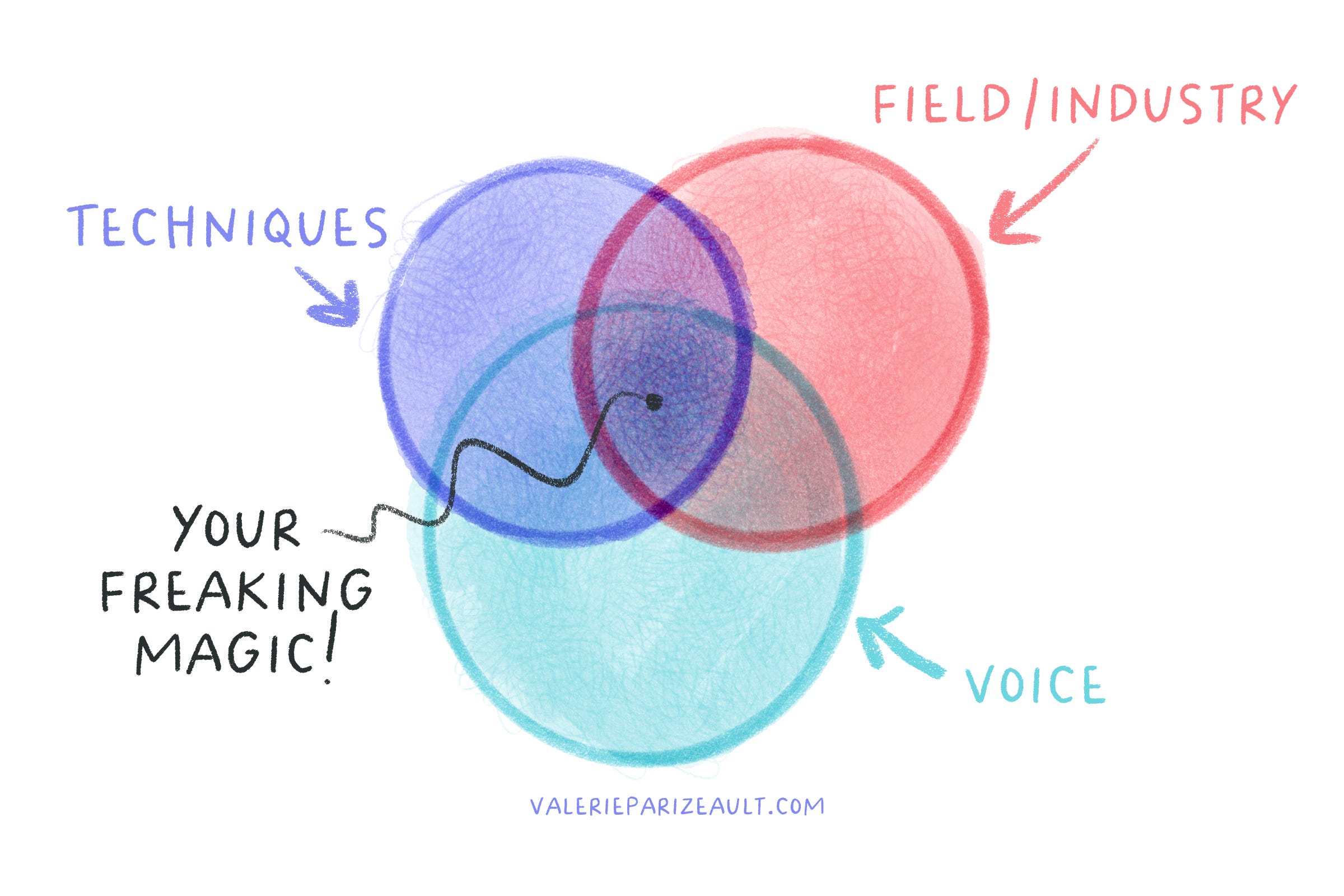
And if you’re asking “but how do I know what the art director is actually looking for?” — you need to do a bit of field research: study the publishers/company you want to work with. Look at their recent releases or products. What’s the emotional tone? What kind of characters? What storytelling style? Then look at your portfolio through their eyes, not yours. You already know how to create, but you also need to know your field and industry. And then, you need to know your voice. In the middle of it all is where you will thrive!
Tell me in the comments: when you look at your portfolio right now, do you see a clear story — or a collection of things you’re proud of? There’s no wrong answer. I just want to know where you’re at.
If you want a structured place to start, I created the Portfolio Gut-Check — a free 10-minute assessment that tells you whether your portfolio is actually working, and where the gaps are.
Get it here → [cliquety-click]
And if the gut-check reveals what I suspect it will — that the real work is getting clear on your brand before you can fix your portfolio — I’m opening the Brand Foundation Workshop in May. Six weeks of building exactly that, together. Waitlist here (click here)→ for early bird pricing.
Bises! Valerie xo
Website | Instagram | LinkedIn
well, in my very bias opinion
duh
Well, maybe in their spare time…
Such a great point, Valerie. I find this is my biggest issue. I like so many things…I’m a graphic designer who illustrates and my focus now is on creating bookplates for clients: for writers & readers and their libraries! That means inevitably I apply my range of styles (classical, abstract/modern, naive, etc) and techniques (watercolor, digital, collage…) to my designs and products because every client is different. Do you agree with this approach? I appreciate your time and thoughts !
This is a great reminder to step back and curate our portfolios and not just put stuff in it to show a lot of work.